I thought it might be illustrative to show you C scores for all the quarterbacks who qualified in 2009. With Kurt Warner retiring at the end of last season, it is certain that not all of them will qualify again in 2010, and, almost assuredly some of the remaining won't qualify in 2010. The difficulty in looking at these players is their body of work. Not all of them will have a C7 score, our standard measure. That being said however, it is still worth a look. Instead of simply limiting the list to those that have a C7 score, we will look at all of their C scores (C1, C4, C7 and C10).
Here's what the list looks like:
Not too many surprises here.
Did you expect someone other than Peyton Manning to be the best passer in the game today? If you did, I'd love to hear from you, and I'd like to see the analysis. Peyton Manning is one of the all-time best (see here and here), and most certainly the greatest passer of his era. Based on C7, I currently have him 7th all-time (C7 of 644), right behind both Fran Tarkenton and Len Dawson who are tied for sixth at 646. He has an outside chance (I'd say about 25%) of catching Sammy Baugh, who is 5th with a C7 of 654.
In the article I wrote on Kurt Warner (see here), I showed that Warner compares favorably to players like Drew Brees, and Tom Brady. In my recent post formally introducing C scores I suggested that as far as the Hall of Fame, that Warner appears to be right on the fence. I certainly would make the argument that Ken Anderson should be in before Warner.
In that same article I also discussed Tom Brady and Drew Brees. I think if they both played long enough that they would both be in the HOF, and I'm fairly certain that Brees would end up as the better passer.
As far as the next group of players, certainly Carson Palmer and Philip Rivers appear to be on their way to becoming good passers, although they've still got a few years ahead of them before we can make any definitive statements.
And finally, looking further out in to the future, I'd say that Matt Schaub is an up-and-comer, and, really taking a flyer, perhaps Aaron Rodgers can parlay his early success to be considered a great passer. Only time will tell.
Showing posts with label C10. Show all posts
Sunday, May 9, 2010
Monday, April 26, 2010
C Scores - A New Way to Evaluate Pro Football's Best Passers of All-Time
It has taken me two years, many, many iterations, and countless hours of mental anguish, but I think I've finally settled on a reliable method by which I can evaluate any quarterback's passing ability versus any other quarterback's passing ability regardless of when they played, or for how long they played. So, for example, I can compare Peyton Manning versus Sammy Baugh, or, Otto Graham versus Brett Favre, or, Sonny Jurgensen versus Dan Marino. You get the point. It all started coming together for me as I wrote my post on Manning versus Brees versus Favre. While I had already figured out how to effectively compare one quarterback's given season to that of another's given season, I had as yet to figure out an effective method by which we evaluated careers.
The inspiration came to me as I read Michael J. Schell's book, Baseball's All-Time Best Hitters, where he went about solving a different problem altogether, but had essentially the same characteristics of the problem I was trying to solve. He was trying to account for the fact that for many hitters with long careers, their batting averages declined after they reached their mid-thirties. And, he didn't think it was fair to compare a hitter who had played into their late thirties or early forties to a player that had not. He chose to account for this by using a "late career adjustment". What he did was to look only at a player's first 8,000 at-bats.
I adopted this notion, and, instead of using a player's first x years, came up with the idea of using his best x years, given that a player's passing ability, as measured by CMTI, and compared to that of his peers tends to be a little volatile from year to year.
Deciding what x was going to be was an issue. I wanted to balance outstanding achievement with duration. In other words, I wanted to see who had performed at an exceedingly high level for a long time. Remember, from my previous post, the average number of years a quarterback qualifies is 4.125. The median is 3.
I thought that a good starting point was to use 4 years. This measure would include 169 players, or a little more than 40% of my database of 416 players going back to when the NFL officially started keeping statistics, and including both the AAFC in the 1940's and the AFL in the 1960's.
If I used 7 years, then I'd get 95 players, or almost 25% of the total. That seemed reasonable for a couple of reasons. First, 25% seemed like a good cut-off, albeit arbitrary. Second, it would allow me to discard the worst years for those quarterbacks who had 8 or more years, which seemed like an appropriate way to reward longevity.
I could have looked at 10 years - in which case, we would be limiting ourselves to 50 quarterbacks, or about 12% of the database, a rather small group, and, as we shall see, excluding many superb passers who didn't quite make it to 10 years. Keep in mind that the median number of years a player qualifies, is 3 years.
My basic method for evaluating a player's performance in a given year is to look at his CMTI, and then, based on the mean and standard deviation for that given year, relate his performance to that of his peers. Since the aggregate accumulation of these measures over the past 78 years looks very much like a normal (bell-shaped) curve, we can use the bell-curve to convert these measures to percentile ranks, giving a numerical value ranging from 1 to 99 for each of these performances. The sum of a given quarterback's 4 best such performances are then used as my C4 calculation, and the sum of his 7 best performances are my C7 calculation. Obviously, then the maximum possible value for C4 is 99 * 4 = 396, and, commensurately, the maximum C7 value is 99 * 7 = 693. As I mentioned earlier, I've also calculated a C10 value for those players with an exceptionally long career. Obviously, if we did this for every year a player qualified, one could create a career C score for each player.
Let's take a look at the lists. We will start with C4.
Wow! What a list. Not bad for starters. Remember, this is a ranking based on a quarterback's 4 best years as a passer. Look at the top 14 on this list. 12 of them are in the Pro Football Hall of Fame! Peyton Manning surely will be when he is done. That's 13 out of 14! Ken Anderson ranks 3rd all-time as a passer according to this list. It is important to keep in mind that this is a list of the top-ranked passers, not top-ranked quarterbacks. It is hard enought to determine a ranking of passers, so it would stand to reason then that it is much harder to determine what makes a top-ranked quarterback. I don't know how the NFL goes about determining who gets in to the Hall of Fame and who deos not, but it sure seems odd that Ken Anderson is the only player in the top 14 on this list that isn't (assuming that Peyton is in, of course).
One of the most aesthetically pleasing aspects of this list, especially looking at the top 15, is that every era and every decade is represented. There does not seem to be a bias. I would think that is an admirable quality of any top-ranked list in that it shows that the measure used to determine who is better, isn't necessarily biased towards a particular era - as opposed to say, the list of top ranked passers (see here and here) in terms of the NFL Passer Rating system at the Pro-Football Hall of Fame.
Look at Steve Young's C4. That's almost unbelievable! The highest C4 possible is 396. In other words, that is being in the 99th percentile four years. Well, Young comes close. His 1996 and 1997 seasons were in the 99th percentile, and his 1992 and 1994 seasons were in the 98th percentile.
In my previous post, we discussed Kurt Warner's merits as a passer. We ignored any discussion about whether he will be enshrined in Canton. Based on this list, it would appear that he is right on the fence.
There are a total of 27 quarterbacks on this list that are members of the Hall of Fame. There are a total of 31 quarterbacks that have been inducted into the Hall of Fame. The four that are in the Hall of Fame, but are not on this list are omitted for good reason. They all played in the 'early years' of the NFL - prior to the keeping of official statistics. They are, Jimmy Conzelman, who played from 1921-1929, John (Paddy) Driscoll, who played from 1920-1929, Earl (Dutch) Clark, who played from 1931-1938 and actually had two very good years in 1934 and 1936, and Benny Friedman, who played from 1927-1934, and who, many during his time argued was the finest passer of his time. It is most unfortunate that we don't have official statistics that would show that.
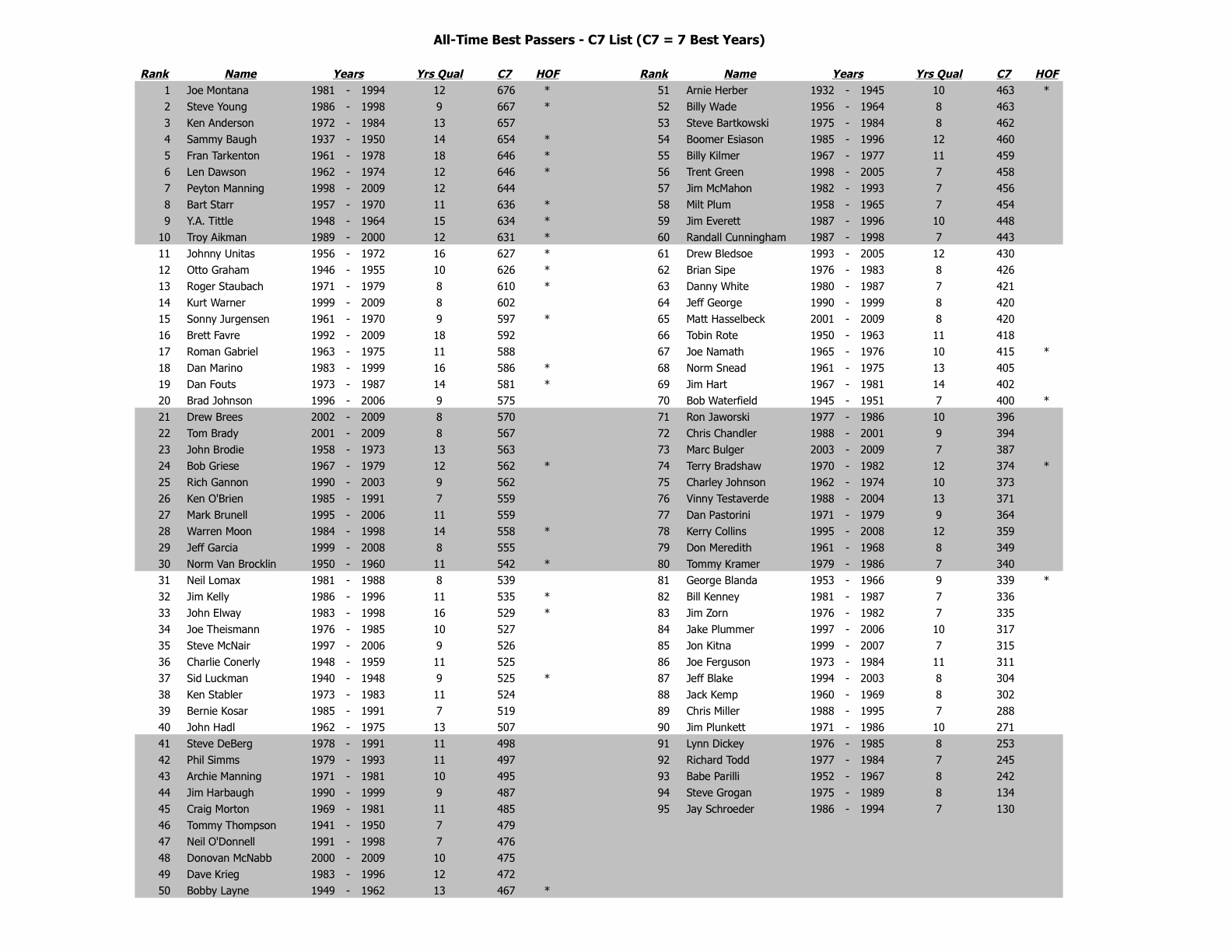
OK, what about C7?
Woah! An even better list than C4! First, while the ordering changed, the top 15 stayed exactly the same as the C4 list, which probably suggests more of the power of the C4 list than anything else (in other words, a quarterback's best 4 years is a pretty good indicator of their passing ability). However, now, we not only have 13 of the top 15 in the HOF (I am considering it a foregone conclusion that Peyton Manning will be inducted into the HOF), but 16 of the top 20 are either in the Hall of Fame or will be (I am also considering it a foregone conclusion that Brett Favre will also be inducted into the HOF). That is a phenomenal list.
It seems obvious then, that, in order to be inducted into the Hall of Fame as a quarterback, one must also have been a great passer. Having said that, it's even more shocking to me now the omission of Ken Anderson from the HOF. I simply do not understand why he is not in. I will have to post an article on Ken Anderson in the near future.
What does C7 say about Kurt Warner? Again, right on the fence.
From my vantage point, it certainly appears that we should be discussing putting Ken Anderson in the Hall of Fame ahead of Kurt Warner.
Finally, we'll take a look at C10. This list only includes 50 quarterbacks, and many exceptional passers are not on this list, simply because they didn't qualify in at least 10 years.
The story is similar to what we've already seen with the C4 and C7 lists. 14 of the top 15 (if you include Peyton Manning and Brett Favre as in the Hall of Fame) are or will be in the Hall of Fame. The lone exception is - you guessed it - Ken Anderson.
There's several conclusions that I can draw from all of this.
I feel pretty good that I've come up with a method by which I can determine the all-time best passers in the history of professional football. I also feel that this method will stand the test of time. It will work regardless of how the game changes over time. It is a method that allows me to conveniently compare players who played in different eras, and it allows me to compare players who have had different career lengths.
Although being inducted into the Hall of Fame as a quarterback shouldn't be a criterion by which we evaluate a quarterback's passing ability, it does provide a reasonableness check of the method I've employed. Given the likelihood of being in the Hall of Fame and showing up at the top of these lists, one could theoretically use it as a measure of whether a quarterback will be inducted into the Hall of Fame. Obviously, there are other factors that enter that equation, but, I can draw some conclusions as to what might be necessary as a passer to be considered a good candidate for the Hall.
A C4 score of 370 or better is a must to be a shoo-in for the Hall. The caveat there being the quarterback would have to had at least 8 seasons where they qualified. Looking at C7, I'd say a C7 score of 625 or better is a requirement, although a score of 600 or better conceivably also works. A C10 score of 775 or better would be considered a must to have any chance of being inducted into the Hall of Fame (in my opinion anyway).
As I mentioned earlier in the article, I think C4 doesn't consider enough years. Conversely, I think C10 is too exclusive. C7 is a good compromise. I could have created a C8 or C6, but C7 feels like it strikes the right balance between excellence and longevity. From now on, I will use C7 as the standard measure of a player's career passing prowess, although I may use C4 and C10 where appropriate. For example, if a player does not have a C7 score, I may use C4 as an early gauge, or, I may use C10 to compare to passers who have had lengthy careers.
Well, now that we've developed the method by which we can fairly present any quarterback's career as a passer, the natural question is, who is the greatest passer of all-time? My method (C7) would suggest it is Joe Montana. Steve Young would come in a close second. You could also look at C4, and you'd see that they are the top 2, although in reverse order. How good Joe Montana was, and for how long he performed at an incredibly high level, is evident by looking at C10 scores. He is the only passer in the history of professional football to have a C10 score exceeding 900, and, at 939, he is 50 ahead of Peyton Manning.
A quick digression here, in case it wasn't obvious. C scores can never decrease, only increase. So for example, Peyton Manning's scores can only increase from here on out. Since we consider a player's best years, if a subsequent year for a player isn't one of the best that already was included in the score, then it wouldn't count towards that score. It would only count if it exceeded, and thereby replaced, one of the years already included. Since Peyton's 10th best season so far is a 79 (his performance in 2007 was in the 79th percentile), he would have to have a performance better than that in the future to increase his C10 score (I would consider that quite likely). On the other hand, his 7th best season is an 85 (his 2009 season), and I'd say that he's only about 50/50 to improve upon that, and thereby increase his C7 score (and if he did improve upon that, he would also improve his C10 score).
So, of the current crop of players, who might eventually knock on the door of the Hall of Fame? Drew Brees and Tom Brady are currently ranked 21 and 22 on the C7 list with scores of 570 and 567, respectively. A few more good years, and they would move up the ladder. For example, in the case of Drew Brees, his score of 570 is made up of scores of 93, 93, 89, 88, 77, 75 and 55. It's almost a guarantee that he would end up dropping the 55. I think it's a foregone conclusion that his C7 score will eventually exceed 600 by a comfortable margin. What about Brady? Well, he is probably already a shoo-in for the Hall on account of his three Super Bowl victories. But, as a passer, he appears a lot weaker than Brees. Brady's C7 score of 567 is made up of scores of 98, 89, 80, 76, 75, 75, and 74. Given his history, I don't see him improving too much from the 567. Perhaps when it is all said and done, he might end up in the 580-590 range. One never knows though.
What about the next generation of passers? Who might be good candidates to have great careers as passers? Chad Pennington, whose current C4 score is 366, one less than that of Kurt Warner, is an interesting case. However, given his history of injuries, he may not be able to accumulate a solid C7 score. If he has one decent year, say, in the 70th percentile, then his C7 score would be 575. There are two players that I think could potentially have great careers based on their current C4 scores - Carson Palmer and Philip Rivers. Based on their yearly scores, I think Philip Rivers might be the better bet, even though Palmer currently has the higher C4 score. Interestingly, Philip Rivers currently ranks 2nd to Steve Young on the all-time passer rating list. Of those who don't even have a C4 score, Matt Schaub has shown excellent early potential.
The inspiration came to me as I read Michael J. Schell's book, Baseball's All-Time Best Hitters, where he went about solving a different problem altogether, but had essentially the same characteristics of the problem I was trying to solve. He was trying to account for the fact that for many hitters with long careers, their batting averages declined after they reached their mid-thirties. And, he didn't think it was fair to compare a hitter who had played into their late thirties or early forties to a player that had not. He chose to account for this by using a "late career adjustment". What he did was to look only at a player's first 8,000 at-bats.
I adopted this notion, and, instead of using a player's first x years, came up with the idea of using his best x years, given that a player's passing ability, as measured by CMTI, and compared to that of his peers tends to be a little volatile from year to year.
Deciding what x was going to be was an issue. I wanted to balance outstanding achievement with duration. In other words, I wanted to see who had performed at an exceedingly high level for a long time. Remember, from my previous post, the average number of years a quarterback qualifies is 4.125. The median is 3.
I thought that a good starting point was to use 4 years. This measure would include 169 players, or a little more than 40% of my database of 416 players going back to when the NFL officially started keeping statistics, and including both the AAFC in the 1940's and the AFL in the 1960's.
If I used 7 years, then I'd get 95 players, or almost 25% of the total. That seemed reasonable for a couple of reasons. First, 25% seemed like a good cut-off, albeit arbitrary. Second, it would allow me to discard the worst years for those quarterbacks who had 8 or more years, which seemed like an appropriate way to reward longevity.
I could have looked at 10 years - in which case, we would be limiting ourselves to 50 quarterbacks, or about 12% of the database, a rather small group, and, as we shall see, excluding many superb passers who didn't quite make it to 10 years. Keep in mind that the median number of years a player qualifies, is 3 years.
My basic method for evaluating a player's performance in a given year is to look at his CMTI, and then, based on the mean and standard deviation for that given year, relate his performance to that of his peers. Since the aggregate accumulation of these measures over the past 78 years looks very much like a normal (bell-shaped) curve, we can use the bell-curve to convert these measures to percentile ranks, giving a numerical value ranging from 1 to 99 for each of these performances. The sum of a given quarterback's 4 best such performances are then used as my C4 calculation, and the sum of his 7 best performances are my C7 calculation. Obviously, then the maximum possible value for C4 is 99 * 4 = 396, and, commensurately, the maximum C7 value is 99 * 7 = 693. As I mentioned earlier, I've also calculated a C10 value for those players with an exceptionally long career. Obviously, if we did this for every year a player qualified, one could create a career C score for each player.
Let's take a look at the lists. We will start with C4.
Wow! What a list. Not bad for starters. Remember, this is a ranking based on a quarterback's 4 best years as a passer. Look at the top 14 on this list. 12 of them are in the Pro Football Hall of Fame! Peyton Manning surely will be when he is done. That's 13 out of 14! Ken Anderson ranks 3rd all-time as a passer according to this list. It is important to keep in mind that this is a list of the top-ranked passers, not top-ranked quarterbacks. It is hard enought to determine a ranking of passers, so it would stand to reason then that it is much harder to determine what makes a top-ranked quarterback. I don't know how the NFL goes about determining who gets in to the Hall of Fame and who deos not, but it sure seems odd that Ken Anderson is the only player in the top 14 on this list that isn't (assuming that Peyton is in, of course).
One of the most aesthetically pleasing aspects of this list, especially looking at the top 15, is that every era and every decade is represented. There does not seem to be a bias. I would think that is an admirable quality of any top-ranked list in that it shows that the measure used to determine who is better, isn't necessarily biased towards a particular era - as opposed to say, the list of top ranked passers (see here and here) in terms of the NFL Passer Rating system at the Pro-Football Hall of Fame.
Look at Steve Young's C4. That's almost unbelievable! The highest C4 possible is 396. In other words, that is being in the 99th percentile four years. Well, Young comes close. His 1996 and 1997 seasons were in the 99th percentile, and his 1992 and 1994 seasons were in the 98th percentile.
In my previous post, we discussed Kurt Warner's merits as a passer. We ignored any discussion about whether he will be enshrined in Canton. Based on this list, it would appear that he is right on the fence.
There are a total of 27 quarterbacks on this list that are members of the Hall of Fame. There are a total of 31 quarterbacks that have been inducted into the Hall of Fame. The four that are in the Hall of Fame, but are not on this list are omitted for good reason. They all played in the 'early years' of the NFL - prior to the keeping of official statistics. They are, Jimmy Conzelman, who played from 1921-1929, John (Paddy) Driscoll, who played from 1920-1929, Earl (Dutch) Clark, who played from 1931-1938 and actually had two very good years in 1934 and 1936, and Benny Friedman, who played from 1927-1934, and who, many during his time argued was the finest passer of his time. It is most unfortunate that we don't have official statistics that would show that.
OK, what about C7?
Woah! An even better list than C4! First, while the ordering changed, the top 15 stayed exactly the same as the C4 list, which probably suggests more of the power of the C4 list than anything else (in other words, a quarterback's best 4 years is a pretty good indicator of their passing ability). However, now, we not only have 13 of the top 15 in the HOF (I am considering it a foregone conclusion that Peyton Manning will be inducted into the HOF), but 16 of the top 20 are either in the Hall of Fame or will be (I am also considering it a foregone conclusion that Brett Favre will also be inducted into the HOF). That is a phenomenal list.
It seems obvious then, that, in order to be inducted into the Hall of Fame as a quarterback, one must also have been a great passer. Having said that, it's even more shocking to me now the omission of Ken Anderson from the HOF. I simply do not understand why he is not in. I will have to post an article on Ken Anderson in the near future.
What does C7 say about Kurt Warner? Again, right on the fence.
From my vantage point, it certainly appears that we should be discussing putting Ken Anderson in the Hall of Fame ahead of Kurt Warner.
Finally, we'll take a look at C10. This list only includes 50 quarterbacks, and many exceptional passers are not on this list, simply because they didn't qualify in at least 10 years.
The story is similar to what we've already seen with the C4 and C7 lists. 14 of the top 15 (if you include Peyton Manning and Brett Favre as in the Hall of Fame) are or will be in the Hall of Fame. The lone exception is - you guessed it - Ken Anderson.
There's several conclusions that I can draw from all of this.
I feel pretty good that I've come up with a method by which I can determine the all-time best passers in the history of professional football. I also feel that this method will stand the test of time. It will work regardless of how the game changes over time. It is a method that allows me to conveniently compare players who played in different eras, and it allows me to compare players who have had different career lengths.
Although being inducted into the Hall of Fame as a quarterback shouldn't be a criterion by which we evaluate a quarterback's passing ability, it does provide a reasonableness check of the method I've employed. Given the likelihood of being in the Hall of Fame and showing up at the top of these lists, one could theoretically use it as a measure of whether a quarterback will be inducted into the Hall of Fame. Obviously, there are other factors that enter that equation, but, I can draw some conclusions as to what might be necessary as a passer to be considered a good candidate for the Hall.
A C4 score of 370 or better is a must to be a shoo-in for the Hall. The caveat there being the quarterback would have to had at least 8 seasons where they qualified. Looking at C7, I'd say a C7 score of 625 or better is a requirement, although a score of 600 or better conceivably also works. A C10 score of 775 or better would be considered a must to have any chance of being inducted into the Hall of Fame (in my opinion anyway).
As I mentioned earlier in the article, I think C4 doesn't consider enough years. Conversely, I think C10 is too exclusive. C7 is a good compromise. I could have created a C8 or C6, but C7 feels like it strikes the right balance between excellence and longevity. From now on, I will use C7 as the standard measure of a player's career passing prowess, although I may use C4 and C10 where appropriate. For example, if a player does not have a C7 score, I may use C4 as an early gauge, or, I may use C10 to compare to passers who have had lengthy careers.
Well, now that we've developed the method by which we can fairly present any quarterback's career as a passer, the natural question is, who is the greatest passer of all-time? My method (C7) would suggest it is Joe Montana. Steve Young would come in a close second. You could also look at C4, and you'd see that they are the top 2, although in reverse order. How good Joe Montana was, and for how long he performed at an incredibly high level, is evident by looking at C10 scores. He is the only passer in the history of professional football to have a C10 score exceeding 900, and, at 939, he is 50 ahead of Peyton Manning.
A quick digression here, in case it wasn't obvious. C scores can never decrease, only increase. So for example, Peyton Manning's scores can only increase from here on out. Since we consider a player's best years, if a subsequent year for a player isn't one of the best that already was included in the score, then it wouldn't count towards that score. It would only count if it exceeded, and thereby replaced, one of the years already included. Since Peyton's 10th best season so far is a 79 (his performance in 2007 was in the 79th percentile), he would have to have a performance better than that in the future to increase his C10 score (I would consider that quite likely). On the other hand, his 7th best season is an 85 (his 2009 season), and I'd say that he's only about 50/50 to improve upon that, and thereby increase his C7 score (and if he did improve upon that, he would also improve his C10 score).
So, of the current crop of players, who might eventually knock on the door of the Hall of Fame? Drew Brees and Tom Brady are currently ranked 21 and 22 on the C7 list with scores of 570 and 567, respectively. A few more good years, and they would move up the ladder. For example, in the case of Drew Brees, his score of 570 is made up of scores of 93, 93, 89, 88, 77, 75 and 55. It's almost a guarantee that he would end up dropping the 55. I think it's a foregone conclusion that his C7 score will eventually exceed 600 by a comfortable margin. What about Brady? Well, he is probably already a shoo-in for the Hall on account of his three Super Bowl victories. But, as a passer, he appears a lot weaker than Brees. Brady's C7 score of 567 is made up of scores of 98, 89, 80, 76, 75, 75, and 74. Given his history, I don't see him improving too much from the 567. Perhaps when it is all said and done, he might end up in the 580-590 range. One never knows though.
What about the next generation of passers? Who might be good candidates to have great careers as passers? Chad Pennington, whose current C4 score is 366, one less than that of Kurt Warner, is an interesting case. However, given his history of injuries, he may not be able to accumulate a solid C7 score. If he has one decent year, say, in the 70th percentile, then his C7 score would be 575. There are two players that I think could potentially have great careers based on their current C4 scores - Carson Palmer and Philip Rivers. Based on their yearly scores, I think Philip Rivers might be the better bet, even though Palmer currently has the higher C4 score. Interestingly, Philip Rivers currently ranks 2nd to Steve Young on the all-time passer rating list. Of those who don't even have a C4 score, Matt Schaub has shown excellent early potential.
Tuesday, March 9, 2010
A Look Back At Kurt Warner's Career As a Passer
On the Friday before Superbowl XLIV, Kurt Warner announced that he was retiring from the NFL.
Of course, the conversations now turn to whether he will be enshrined in Canton. There are those who say yes, some who say maybe, and those who say no. The fact is, we don't know. There is no formula to get in.
In many of the posts on the topic, the usual comparisons are made. The easiest comparisons are to his peers - Manning, Brady, Favre, Brees, and others. The other comparisons I've seen are to players like Dan Fouts, Jim Kelly, Troy Aikman, and Warren Moon, all four of whom are in Canton.
My post is not about whether he was a good quarterback or not, and whether he should or should not be in the Hall of Fame. This post is about whether or not he was a good passer. And how did he compare to his peers? And where would he rank in terms of recent quarterbacks who have retired? And how would he compare to all quarterbacks? These are the questions I will explore. All of these questions will be answered in the context of his passing ability in relation to the others.
Ok, let's start with a look back at his performance over the years.
Several things jump out at me.
His career passer rating, for one. It's very high. According to the Pro Football Hall of Fame, Warner's career passer rating of 93.7 ranks fifth best all-time, behind Steve Young, Philip Rivers, Tony Romo and Peyton Manning. As I have discussed before, the NFL passer rating formula isn't a very meaningful way to compare quarterbacks over time. I'll discuss how we adjust the passer rating, and even simplify it, and then compare that figure to his peers, in order to get a more meaningful picture. The average passer rating of 95.1 shown above differs from that shown by the Pro Football Hall of Fame simply because mine is just a simple average of each year.
Another fact that jumps out at me is that he got a late start. He didn't start really playing until he was 28. In my database of 416 quarterbacks going all the way back to 1932, including players from both the AAFC in the late 1940's and the AFL in the 1960's, and only looking at quarterbacks who have qualified in 8 or more years, only 7 quarterbacks had their first qualifying season at age 28 or later. For all quarterbacks who qualified in at least 8 seasons, both the median and mean age at which they qualified in their first season is 24. There are a total of 77 quarterbacks who qualified in at least 8 seasons. Keep in mind that the average number of years in which a quarterback qualifies (given that he qualifies in at least 1 year) is 4.125, and median number of years is 3. So to be one of only 7 quarterbacks who began at age 28 or later and qualify in 8 different seasons is pretty rare company. The other six players are Jeff Garcia and Roger Staubach at age 29, and Warren Moon, Billy Kilmer, Ken Stabler, and Brad Johnson at age 28. Note that Staubach and Moon are both in the Hall of Fame.
Next thing I notice is that there are many gaps in his career. He got injured, then was signed by the NY Giants as an insurance policy against Eli Manning. Following that, he ended up getting an opportunity to play in Arizona, until the Cardinals drafted Matt Leinart. When Leinart got hurt in the fifth game of the 2007 season, Kurt stepped in, and went on to lead the Cardinals into Superbowl XLIII, and into the playoffs this past season, where the Cardinals lost to eventual Superbowl Champs New Orleans.
It is extremely difficult to use the NFL Passer Rating system, especially the career passer rating for a given quarterback to see how they compare to other quarterbacks. Just take a look at the list provided by the Pro Football Hall of Fame. This is simply not a list of the best passers over time. It merely reflects the fact that the passer rating calculation favors current passers. I have previously shown (here) why this is not an accurate reflection of passing ability.
Perhaps one way to adjust the passer rating is to reflect the standards such that the average in each year turns out to be 66.7 (as the intended application of the passer rating). See my post on the subject here. In that regard, Warner's (adjusted) career passer rating is around 83. Of the 416 quarterbacks, that would rank him 23rd. Of the quarterbacks qualifying in 8 or more years, it would rank him 10th.
While the Adjusted Passer Rating is better than the NFL Passer Rating, in that at least one can compare quarterbacks from one era with those of another, it's still not an ideal (or simple) measure of a passer's effectiveness. I've used CMTI in the past, and I'll use it here. More specifically, I'll use the CMTIPR, or percentile rank of CMTI.
In my previous post, I compared Manning, Favre and Brees using CMTIPR. We had to adjust CMTIPR for length of career, and I used their best seasons as the measure. At the end of that post, a graphical illustration showed the effect. I've since improved upon that concept. Using the concept of "Best Seasons", I've come up with 4 statistical measures, C1, C4, C7 and C10, that basically shows a given quarterback's best season (C1), 4 best seasons (C4), 7 best seasons (C7) and 10 best seasons (C10). C1 is simply the quarterback's best season in terms of percentile rank of CMTI. C4 is similarly the sum of the percentile ranks of his 4 best seasons, and so on.
So let's take a look at Warner, and how he compares to Manning, Favre, and Brees.
Obviously, neither Brees nor Warner will have a C10 score as they've not had 10 seasons in which they qualified. I don't think one can evaluate a career based on 1 year, so let's not use C1. It is shown simply for illustration purposes to highlight their best year. So that leaves us with C4 or C7. In order to truly define greatness, one must exemplify superior performance, but also perform at that level for a number of years. The more years performing at a high level, the greater the player. I think that C7 strikes a good balance. In my database, there are 50 quarterbacks who have a C10 score, 95 quarterbacks who have a C7 score, and 169 quarterbacks who have a C4 score. So, at least based on a C7 score, Warner compares very favorably to Manning, Favre and Brees.
We will go into much more details regarding the C scores for quarterbacks in my next post.
Of course, the conversations now turn to whether he will be enshrined in Canton. There are those who say yes, some who say maybe, and those who say no. The fact is, we don't know. There is no formula to get in.
In many of the posts on the topic, the usual comparisons are made. The easiest comparisons are to his peers - Manning, Brady, Favre, Brees, and others. The other comparisons I've seen are to players like Dan Fouts, Jim Kelly, Troy Aikman, and Warren Moon, all four of whom are in Canton.
My post is not about whether he was a good quarterback or not, and whether he should or should not be in the Hall of Fame. This post is about whether or not he was a good passer. And how did he compare to his peers? And where would he rank in terms of recent quarterbacks who have retired? And how would he compare to all quarterbacks? These are the questions I will explore. All of these questions will be answered in the context of his passing ability in relation to the others.
Ok, let's start with a look back at his performance over the years.
Several things jump out at me.
His career passer rating, for one. It's very high. According to the Pro Football Hall of Fame, Warner's career passer rating of 93.7 ranks fifth best all-time, behind Steve Young, Philip Rivers, Tony Romo and Peyton Manning. As I have discussed before, the NFL passer rating formula isn't a very meaningful way to compare quarterbacks over time. I'll discuss how we adjust the passer rating, and even simplify it, and then compare that figure to his peers, in order to get a more meaningful picture. The average passer rating of 95.1 shown above differs from that shown by the Pro Football Hall of Fame simply because mine is just a simple average of each year.
Another fact that jumps out at me is that he got a late start. He didn't start really playing until he was 28. In my database of 416 quarterbacks going all the way back to 1932, including players from both the AAFC in the late 1940's and the AFL in the 1960's, and only looking at quarterbacks who have qualified in 8 or more years, only 7 quarterbacks had their first qualifying season at age 28 or later. For all quarterbacks who qualified in at least 8 seasons, both the median and mean age at which they qualified in their first season is 24. There are a total of 77 quarterbacks who qualified in at least 8 seasons. Keep in mind that the average number of years in which a quarterback qualifies (given that he qualifies in at least 1 year) is 4.125, and median number of years is 3. So to be one of only 7 quarterbacks who began at age 28 or later and qualify in 8 different seasons is pretty rare company. The other six players are Jeff Garcia and Roger Staubach at age 29, and Warren Moon, Billy Kilmer, Ken Stabler, and Brad Johnson at age 28. Note that Staubach and Moon are both in the Hall of Fame.
Next thing I notice is that there are many gaps in his career. He got injured, then was signed by the NY Giants as an insurance policy against Eli Manning. Following that, he ended up getting an opportunity to play in Arizona, until the Cardinals drafted Matt Leinart. When Leinart got hurt in the fifth game of the 2007 season, Kurt stepped in, and went on to lead the Cardinals into Superbowl XLIII, and into the playoffs this past season, where the Cardinals lost to eventual Superbowl Champs New Orleans.
It is extremely difficult to use the NFL Passer Rating system, especially the career passer rating for a given quarterback to see how they compare to other quarterbacks. Just take a look at the list provided by the Pro Football Hall of Fame. This is simply not a list of the best passers over time. It merely reflects the fact that the passer rating calculation favors current passers. I have previously shown (here) why this is not an accurate reflection of passing ability.
Perhaps one way to adjust the passer rating is to reflect the standards such that the average in each year turns out to be 66.7 (as the intended application of the passer rating). See my post on the subject here. In that regard, Warner's (adjusted) career passer rating is around 83. Of the 416 quarterbacks, that would rank him 23rd. Of the quarterbacks qualifying in 8 or more years, it would rank him 10th.
While the Adjusted Passer Rating is better than the NFL Passer Rating, in that at least one can compare quarterbacks from one era with those of another, it's still not an ideal (or simple) measure of a passer's effectiveness. I've used CMTI in the past, and I'll use it here. More specifically, I'll use the CMTIPR, or percentile rank of CMTI.
In my previous post, I compared Manning, Favre and Brees using CMTIPR. We had to adjust CMTIPR for length of career, and I used their best seasons as the measure. At the end of that post, a graphical illustration showed the effect. I've since improved upon that concept. Using the concept of "Best Seasons", I've come up with 4 statistical measures, C1, C4, C7 and C10, that basically shows a given quarterback's best season (C1), 4 best seasons (C4), 7 best seasons (C7) and 10 best seasons (C10). C1 is simply the quarterback's best season in terms of percentile rank of CMTI. C4 is similarly the sum of the percentile ranks of his 4 best seasons, and so on.
So let's take a look at Warner, and how he compares to Manning, Favre, and Brees.
Obviously, neither Brees nor Warner will have a C10 score as they've not had 10 seasons in which they qualified. I don't think one can evaluate a career based on 1 year, so let's not use C1. It is shown simply for illustration purposes to highlight their best year. So that leaves us with C4 or C7. In order to truly define greatness, one must exemplify superior performance, but also perform at that level for a number of years. The more years performing at a high level, the greater the player. I think that C7 strikes a good balance. In my database, there are 50 quarterbacks who have a C10 score, 95 quarterbacks who have a C7 score, and 169 quarterbacks who have a C4 score. So, at least based on a C7 score, Warner compares very favorably to Manning, Favre and Brees.
We will go into much more details regarding the C scores for quarterbacks in my next post.
Subscribe to:
Posts (Atom)